Gates Cambridge Scholarship 2027 for Pakistani Students: Step-by-Step Application Guide
By Site Admin · Oct 13, 2026 · 28 min read
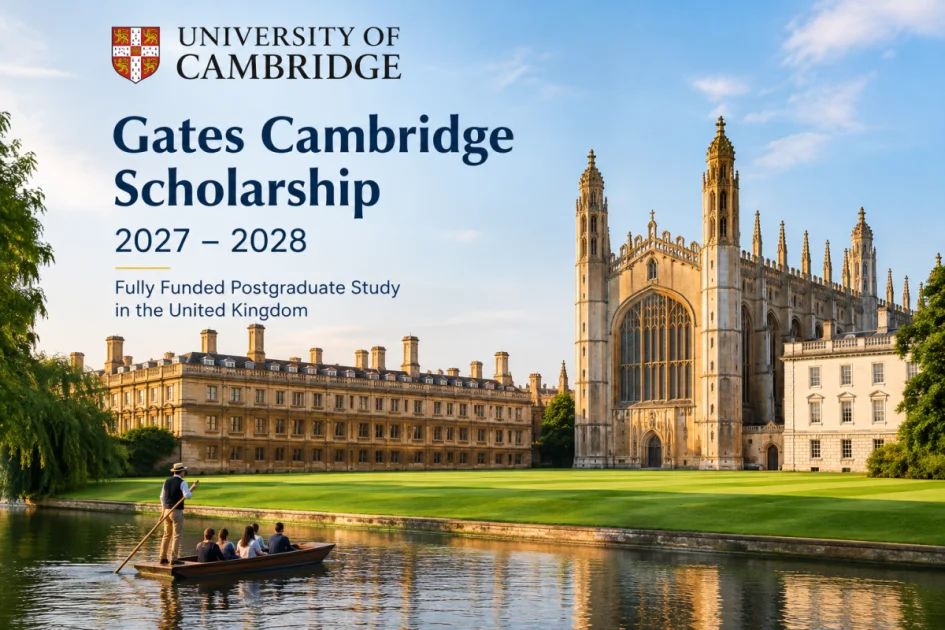
Gates Cambridge Scholarship 2027–2028 — Research findings for Pakistani students
Research status: Pakistan is included among the nationalities eligible to apply for the international round of Gates Cambridge. The University of Cambridge's official postgraduate funding database lists the scholarship for the 2027–2028 academic year, with approximately 55 awards available in the international round.
Important deadline note: There is no single international-round deadline for every applicant. The deadline depends on the postgraduate course selected at Cambridge, and applicants must meet the earlier deadline if the course and scholarship funding deadlines differ. The official Cambridge funding listing directs international applicants to their course-specific funding deadline.
The package below distinguishes confirmed information from details that must be checked against the relevant course page. The Gates Cambridge website was not fully accessible through the research interface, so unverified amounts and dates are not presented as established facts.
PART 1 — Scholarship listing
Tab 1: Basics
Field | Value |
|---|---|
Title | Gates Cambridge Scholarship 2027–2028 in the UK |
Slug |
|
Country | United Kingdom |
Provider | Gates Cambridge Trust, University of Cambridge |
Funding Type | Fully Funded |
Funding Percentage | 100% of eligible core study costs |
Levels | Masters, PhD |
Fields | All eligible postgraduate fields at the University of Cambridge |
Status | Draft |
Is Featured | Yes |
Is Editor's Pick | Yes |
Eligibility Pakistan | Yes |
Academic Year | 2027–2028 |
Deadline | Course-dependent: 2026-12-08 or 2027-01-06; verify the selected course |
Application Opens | 2026-09-11, reported by secondary sources; confirm against the official portal |
The international award is intended for applicants from countries outside the UK. Pakistani citizens should apply through the international round, not the US round. Cambridge's official postgraduate funding listing identifies approximately 55 international awards for 2027–2028.
Tab 2: Coverage & amounts
Field | Value |
|---|---|
Stipend Amount | Verify manually for 2027–2028 |
Stipend Currency | GBP |
Duration Value | Varies by eligible course |
Duration Unit | Months or years, according to course length |
Tuition Covered | Yes |
Travel Covered | Yes, eligible travel to and from the UK |
Insurance Covered | Yes, including the UK Immigration Health Surcharge |
Accommodation Covered | Supported through the maintenance allowance; separate accommodation payment not confirmed |
Living Allowance Covered | Yes |
Deadline Note | The applicable deadline is the earlier of the relevant course and funding deadlines. Check the individual Cambridge course page. |
The University of Cambridge's official funding listing describes an annual package potentially worth approximately £35,000–£68,000, depending on the course and applicable funding components. This is an indicative total package, not a guaranteed cash payment. Tuition, maintenance, travel, visa expenses and discretionary support are different components of the award.
Do not publish a fixed 2027–2028 stipend or calculate a total award value until the applicable maintenance rate and course fees have been verified.
Tab 3: Eligibility details
Field | Value |
|---|---|
Min Age | Not specified as a general scholarship-wide minimum |
Max Age | No general scholarship-wide maximum confirmed |
Min GPA | No universal numerical GPA threshold confirmed |
IELTS Required | Leave blank; Cambridge's English-language requirements apply |
TOEFL Required | Leave blank; Cambridge's English-language requirements apply |
Work Experience Years | No universal minimum confirmed |
These fields should not be converted into invented numerical thresholds. Applicants must satisfy the academic and English-language requirements of their selected course, as well as the scholarship's selection criteria.
Tab 4: Content fields
Overview
The Gates Cambridge Scholarship supports outstanding postgraduate students from countries outside the United Kingdom who intend to study at the University of Cambridge. Established through funding from the Gates Foundation, the programme combines financial support with a selection process focused on academic excellence, leadership, course suitability and a demonstrated commitment to improving the lives of others. It offers approximately 75 awards worldwide each year, divided between the US and international application rounds. The international round accounts for approximately 55 awards.
For the 2027–2028 academic year, Pakistani citizens can apply through the international round. The scholarship covers eligible tuition fees and living costs, together with specified travel, immigration and other support. The Cambridge postgraduate funding database lists the international award for the current cycle, with deadlines determined by the selected course. Secondary sources identify 8 December 2026 and 6 January 2027 as the main international deadlines, but applicants must confirm the exact date and time shown on their individual course page. The award is competitive and does not guarantee admission to Cambridge merely because an applicant meets the basic eligibility requirements.
Benefits
University tuition fees: The scholarship covers the applicable University Composition Fee for the approved course.
Living expenses: Scholars receive a maintenance allowance. The amount applicable to 2027–2028 must be confirmed before publishing a fixed figure.
Travel: Eligible travel expenses for journeys to and from the UK are covered under the award's terms.
Immigration costs: Eligible UK student visa expenses and the Immigration Health Surcharge are included.
Academic development: Discretionary support may be available for eligible academic activities, such as conferences.
Fieldwork: Additional assistance may be available for qualifying research-related travel or fieldwork.
Family support: A dependant-children allowance may be available to eligible scholars with children. It should not be described as an automatic allowance for every family member.
Other discretionary assistance: Additional support may be available for qualifying circumstances under the Trust's rules.
Total value: Cambridge lists an indicative annual funding package of approximately £35,000–£68,000. This is not a guaranteed cash award and should not be multiplied by the course duration to produce a fixed lifetime value without checking the student's course fees and funding terms.
Eligibility
Basic requirements
You must be a citizen of a country outside the United Kingdom. Pakistani citizens meet the nationality condition for the international round.
You must apply for an eligible postgraduate course at the University of Cambridge.
Applicants who are US citizens normally resident in the United States should follow the separate US round instead.
You must demonstrate that your goals and experience align with the scholarship's selection criteria.
Academic requirements
You must meet the entry requirements of your selected Cambridge course.
Your academic record should demonstrate the ability to succeed in demanding postgraduate study.
Check whether your intended course requires a particular undergraduate degree, a master's qualification, a research proposal or specific subject preparation.
Pakistani degree holders should confirm the University's country-specific academic equivalencies and documentation requirements.
Work experience
No universal minimum number of employment years has been confirmed for the scholarship as a whole. Leadership may be demonstrated through employment, research, community work, entrepreneurship, volunteering or other relevant activities. Applicants should not assume that a particular number of paid work years is mandatory.
English-language requirements
Gates Cambridge does not establish a universal IELTS or TOEFL score that replaces Cambridge's own requirements. The relevant department determines which English-language evidence it accepts and the required score, where applicable. Applicants educated in Pakistan should check the course-specific rules rather than assuming that an English-medium degree automatically waives testing.
Ineligibility and restrictions
Applicants seeking an undergraduate degree cannot use this postgraduate scholarship.
Admission to Cambridge and selection for Gates Cambridge are separate decisions.
Not every course or degree type is eligible; applicants must check the scholarship's approved course restrictions.
Applicants must use the correct application round and meet all course-specific requirements.
False or incomplete information can jeopardise both admission and funding.
Pakistan-specific notes
Pakistani applicants should apply through the international round. HEC nomination is not identified as a general requirement for Gates Cambridge, and applicants should not assume that HEC attestation is required at the initial scholarship stage. Follow Cambridge's instructions for transcripts, degree certificates, translations and any later immigration or enrolment documentation.
Required documents
At application submission
Completed University of Cambridge graduate application.
Academic transcripts and degree certificates required by the chosen course.
Curriculum vitae, if required by the department or course.
Personal statements and scholarship-specific responses requested in the application portal.
Academic references required by the course.
The additional Gates Cambridge reference.
Research proposal, where required for the chosen research degree.
English-language evidence, if required at that stage.
If shortlisted for interview
Valid passport or other identity documentation, if requested.
Updated academic or professional information if the Trust requests it.
Evidence supporting relevant leadership, community, research or professional claims.
Preparation for questions about academic plans, leadership and intended contributions to society.
Before starting studies
Final degree documents and any outstanding academic conditions.
Proof of English proficiency, if required.
UK student visa documentation.
Evidence of financial or immigration information requested by the University.
Original or appropriately certified documents when required by the University or relevant authorities.
Pakistan-specific document guidance: Use the spelling and personal details shown on your passport consistently. Obtain official English translations for documents that are not in English. Do not pay for HEC attestation or other certification solely on the assumption that Gates Cambridge requires it; first check the actual instructions for your admission and enrolment process.
Application process
Choose a course. Open the University of Cambridge postgraduate course directory and identify an eligible programme for 2027–2028.
Check the deadline. Locate the course's funding deadline. International-round deadlines are reported as 8 December 2026 or 6 January 2027, depending on the course. Do not use the US-round deadline of 14 October 2026 for a Pakistani applicant.
Review admission requirements. Confirm degree equivalencies, English-language rules, references, supporting documents and any course-specific tests.
Contact a potential supervisor if appropriate. Research-degree applicants should read the department's guidance and establish whether supervisor contact is recommended or required.
Prepare your academic evidence. Arrange transcripts, degree certificates, a CV and any research proposal required by the course.
Develop your scholarship responses. Explain your academic plans, why Cambridge is appropriate, your leadership experience and how your work could improve the lives of others.
Select suitable referees. Approach them early, explain the scholarship's criteria and allow enough time for them to submit their references.
Complete the graduate application. Enter the admission information and complete the Gates Cambridge funding section in the portal.
Submit every required component. Make sure references and supporting documents are received by the applicable deadline, not merely that the main form has been submitted.
Monitor your application. Check your email and applicant portal for requests, decisions and interview instructions.
Prepare for selection. If invited, be ready to discuss your proposed study, leadership, contribution to society and fit with Cambridge.
Complete admission and immigration requirements. If selected, respond to the award offer within the stated period and follow the University's enrolment and visa instructions.
The official Cambridge postgraduate funding record should be used to verify the applicable deadline and funding terms.
Additional info
Annual awards: Approximately 75 worldwide, with about 55 in the international round and 20 in the US round.
Interview location: Do not promise an in-person interview in Islamabad or another Pakistani city. Confirm the format and arrangements in the official invitation.
Regional preferences: No Pakistan-specific regional preference has been confirmed for this award.
Selection criteria: Academic excellence, reasons for choosing the course, commitment to improving the lives of others and leadership capacity.
Funding limitations: Research consumables and other costs may be excluded or handled through different University arrangements. Applicants should check the award conditions for their specific course.
Tab 5: Links & media
Field | Value |
|---|---|
Application URL | https://www.postgraduate.study.cam.ac.uk/application-process |
Official Source URL | https://www.student-funding.cam.ac.uk/fund/gates-cambridge-scholarship-2026 |
Scholarship website | |
Featured Image | A generic photograph of the University of Cambridge, showing university architecture or a historic college courtyard |
Featured Image Alt | University of Cambridge college buildings in Cambridge, United Kingdom |
Image sourcing note: Use a properly licensed image from Unsplash or another source with suitable commercial-use terms. Do not download images from the official scholarship website without checking the relevant image rights.
Tab 6: FAQs
1. What is the deadline for Pakistani students applying for Gates Cambridge in 2027?
The deadline depends on the Cambridge postgraduate course. For the 2027–2028 cycle, secondary sources identify 8 December 2026 and 6 January 2027 as the principal international-round deadlines. Pakistani citizens apply through the international round, not the US round, which has a separate deadline of 14 October 2026. Check the funding deadline on your chosen course's official Cambridge page and submit all required documents and references by that deadline. The course-specific date takes precedence over a generic scholarship listing.
2. Can Pakistani students apply without work experience?
There is no confirmed universal minimum of paid work experience for all Gates Cambridge applicants. The selection process considers leadership and a commitment to improving the lives of others, but these qualities may be demonstrated through academic projects, research, community involvement, volunteering, entrepreneurship or professional work. Applicants should read the criteria and present specific evidence of what they have contributed and learned. Do not invent leadership titles or exaggerate achievements. The most important next step is to ensure that your academic profile and intended Cambridge course meet the programme's requirements.
3. Do Pakistani applicants need IELTS or TOEFL?
There is no single Gates Cambridge IELTS or TOEFL score that applies to every course. English-language requirements are set by the University and may vary by department, degree and applicant circumstances. Check the English-language section of your chosen course's official page and determine which tests and exemptions are accepted. If a test is required, allow sufficient time to book it and receive results before the relevant deadline. Do not assume that an English-medium Pakistani degree automatically grants an exemption, and do not enter a numerical score in a scholarship listing unless the applicable official rule supports it.
4. How much money does Gates Cambridge provide?
The University of Cambridge lists an indicative annual funding package of approximately £35,000–£68,000, depending on the course and applicable funding components. The scholarship covers eligible tuition fees and maintenance and can also include travel, visa and Immigration Health Surcharge costs. Some additional funding is discretionary. The published package value should not be presented as the amount deposited into a student's bank account. Before publishing a precise stipend for 2027–2028, confirm the maintenance rate and the relevant course's tuition fee.
5. Can I bring my spouse or children to the UK?
The scholarship's funding information identifies a possible dependant-children allowance for eligible scholars, but this should not be interpreted as an automatic payment for every spouse or family member. UK immigration permission for dependants is also governed by the rules applicable to the student's course and circumstances. Before making family travel plans, check the current UK government student-visa guidance and ask Gates Cambridge to clarify which family-related costs, if any, are covered by your award. Do not assume that the scholarship pays all living, travel or visa expenses for accompanying relatives.
6. What happens if I do not receive an unconditional Cambridge offer before the scholarship deadline?
You should follow the admission conditions and funding deadlines specified by Cambridge. Do not wait for an unconditional offer if the application instructions require you to submit your complete admission and scholarship application by an earlier funding deadline. The scholarship and course admission processes are linked, and outstanding references or missing documents can prevent an application from being considered complete. If your qualifications, language results or other conditions are pending, contact the relevant department or admissions team for written clarification before the deadline. Do not assume that an extension will be granted.
7. Can I apply if I have already studied in the UK?
Previous study in the UK is not, by itself, a sufficient basis for deciding whether an applicant qualifies. The answer depends on the scholarship's current eligibility rules, the proposed course and the applicant's circumstances. Applicants should read the official eligibility guidance and verify any restriction relevant to their previous degree or study history before submitting an application. A previous UK degree should not automatically be treated as either an exemption or a disqualification without an applicable rule. If the official guidance is unclear, request clarification from Gates Cambridge.
8. Where are Gates Cambridge interviews held for Pakistani applicants?
Do not assume that every Pakistani applicant will attend an interview in Islamabad or another specific city. Interview arrangements should be confirmed through the official invitation, including whether the interview is online or in person, the scheduled time and any travel requirements. If you are shortlisted, review the selection criteria and prepare to discuss your academic work, course choice, leadership and intended contribution to society. Keep your passport and application details available if requested, and do not book non-refundable travel before the interview format and location have been confirmed.
Gates Cambridge Scholarship 2027–2028: A practical application guide for Pakistani students
Opening: What makes this application different?
Around 55 Gates Cambridge Scholarships are available in the international round each year, according to the University of Cambridge's postgraduate funding information. That makes this a highly competitive funding route for students seeking postgraduate study in the UK. The award is not simply a tuition-fee discount: it is designed to support eligible study costs and identify people who combine academic strength with leadership and a commitment to improving the lives of others.
For Pakistani applicants, preparation involves two connected tasks: gaining admission to a suitable Cambridge postgraduate course and building a convincing scholarship application. A strong academic record matters, but you also need a clear explanation of why the particular course is right for you and how you intend to use what you learn.
This guide covers how to check eligibility, select a programme, prepare documents, develop your application responses and get ready for selection. It also explains where Pakistani applicants should be especially careful about deadlines, references and supporting evidence.
For the award amount, official application links and current funding conditions, consult the Gates Cambridge Scholarship listing on Scholarship Ledger once that page has been published. Until then, use the official Gates Cambridge website and Cambridge's postgraduate funding database for verification.
Before you start — eligibility reality check
Before spending weeks preparing essays, establish whether the scholarship and the course match your circumstances. The first mistake applicants make is treating eligibility as a single question. In practice, you need to satisfy the scholarship's rules and the University's separate admission requirements.
Check your nationality and application round. Pakistani citizens are eligible to apply through the international round because the scholarship is for applicants from countries outside the UK. The separate US round is intended for US citizens normally resident in the United States. A deadline advertised for that round should not be used for a Pakistani applicant.
Check the qualification required for your intended course. Gates Cambridge is a postgraduate scholarship, not a direct undergraduate funding programme. Read the course entry requirements carefully. A master's applicant and a PhD applicant may need different qualifications, academic preparation and supporting documents. Some research degrees require a proposal or other evidence of research readiness.
Do not assume that meeting minimum admission requirements makes you competitive. Admission requirements establish whether the University can consider your application. The scholarship also evaluates academic excellence, reasons for choosing the course, leadership and commitment to improving the lives of others. These are separate questions that your application should address directly.
Review your academic record honestly. Gather your transcripts, degree certificates and information about your grading system. If your final degree has not yet been awarded, determine whether the department accepts an application with pending results and what evidence it requires. Never represent a qualification as completed if it is still in progress.
Confirm English-language requirements. Do not rely on a generic IELTS score found on a scholarship blog. Cambridge's language requirements may vary by course and individual circumstances. Check the course page to determine whether IELTS, TOEFL or another form of evidence is accepted, and whether an exemption may apply.
Look beyond paid employment when presenting leadership. Leadership can be shown through a research project, a community initiative, a student organisation, a professional responsibility or an effort to solve a problem affecting other people. You need evidence of what you actually did, rather than a list of impressive-sounding titles.
Finally, review any course restrictions and the official scholarship eligibility guidance before preparing your final application. If a rule is unclear, obtain clarification from the scholarship team or department rather than relying on an aggregator's summary.
The 2027–2028 application timeline
The international round is the relevant route for most Pakistani applicants. Cambridge's funding database confirms that the deadline depends on the selected course. Secondary sources report two principal international deadlines: 8 December 2026 and 6 January 2027. The applicable date must be verified against the official course page.
Milestone | Date or timing | What you should do |
|---|---|---|
Application preparation | Begin immediately | Select courses and review their admission requirements |
Reported opening date | 11 September 2026 | Confirm the application portal is accepting applications |
First reported international deadline | 8 December 2026 | Submit by this date if it is the deadline shown for your course |
Second reported international deadline | 6 January 2027 | Use only if the official page for your course specifies this date |
Reported first-stage outcome | By 8 March 2027 | Monitor official email and the application portal |
Reported international interviews | 22–23 March 2027 | Follow the actual invitation and confirmed arrangements |
Reported scholarship offers | By early April 2027 | Review the offer terms and respond within the stated period |
The opening date and later selection milestones above are reported by secondary sources and require final confirmation against current official guidance. They should not be treated as guaranteed dates until verified.
Pakistan time conversion: During December and January, the UK is generally on GMT and Pakistan is on Pakistan Standard Time, which is 5 hours ahead. If a deadline is 11:59 pm UK time, that corresponds to 4:59 am the following day in Pakistan. Always check the time zone stated on the actual application portal.
The strictest milestone is the deadline for the complete application. Do not assume you can submit the form first and send references later. Cambridge guidance for scholarship applications stresses that required references must be received before the applicable deadline.
Choosing your Cambridge course and preparing the application
Your choice of course should be based on academic fit, not only on the availability of funding. Gates Cambridge supports eligible postgraduate study, but the selected programme must meet the scholarship's current rules.
Start with the course directory. Browse the official postgraduate course directory. Shortlist programmes that connect with your academic background and longer-term goals. Compare entry qualifications, research areas, course duration, funding deadlines and any additional application requirements.
For a PhD, investigate the department's research environment and identify potential supervisors whose work aligns with your interests. A research proposal should demonstrate that you understand the question you want to investigate, why it matters and how you might approach it. Do not choose a supervisor simply because their name appears frequently in online discussions.
For a taught master's programme, examine the curriculum and explain why its particular modules, methods or academic strengths are appropriate for your next step. A generic statement about wanting to study at a famous university will not explain why you need that specific course.
Develop a clear academic argument. Your application should connect 3 elements:
What you have already studied or investigated.
What you need to learn next and why Cambridge is suitable.
What you intend to do with that knowledge.
For example, an applicant interested in public health might explain how previous research revealed a problem in health-service delivery, which research methods they now need to learn, and how they plan to apply that expertise to improve health systems. This is an illustrative structure, not a claim about any particular applicant's achievements.
Prepare scholarship responses separately from your admission statement. The admission application explains your readiness for the course. The scholarship responses must also communicate your fit with the programme's selection criteria. Repeating the same biography in every section wastes space and can make the application feel unfocused.
Choose evidence rather than adjectives. Instead of writing that you are a natural leader, describe a situation where you took responsibility, what you changed, who benefited and what you learned. Where possible, quantify the scale of your contribution, but only when the figures are accurate and can be explained.
Use your Pakistani context thoughtfully. You may have experience with problems that deserve further research or practical intervention, such as access to education, public services, technology or health care. Explain the problem clearly and demonstrate why your proposed academic work could help. Do not assume that being Pakistani is itself a selection advantage; the value lies in the quality of your experience, reasoning and intended contribution.
Coordinate your references early. Give referees your CV, academic record, course details and a summary of the scholarship criteria. Ask them to submit their references directly through the official process. Make sure they understand that a scholarship reference may need to discuss your character, leadership and broader contribution, not only your grades.
Proofread the entire application. Check that course names, dates, qualifications and research claims match your supporting documents. Keep a copy of each submitted response and confirm that the portal shows the application as complete.
Interview and selection process
Gates Cambridge assesses candidates on academic excellence, reasons for choosing their course, commitment to improving the lives of others and leadership capacity. These criteria should guide your interview preparation.
If you are invited to an interview, read the invitation carefully before making arrangements. The location, format, time zone and required documents must come from the official instructions. Do not assume that Pakistani candidates will necessarily be interviewed in Islamabad or that every interview is conducted online.
Prepare to explain your academic choices. Be ready to discuss the problem you want to investigate, the methods or knowledge you need, and why your chosen Cambridge programme is a good fit. If you are applying for a research degree, expect to explain the logic of your proposal and acknowledge its limitations.
Prepare concrete leadership examples. Choose 2 or 3 situations in which you took responsibility, helped a team, addressed a challenge or contributed to a wider community. Explain your role precisely. Interviewers should be able to distinguish what you personally achieved from what a larger group accomplished.
Explain how your work could benefit others. A convincing answer does not need to promise a dramatic transformation. It should identify a real problem, describe a plausible contribution and show that you understand the limits of your own role. Discuss how your plans might evolve as you gain new knowledge.
Demonstrate that you understand the course. Read the department's research information and relevant programme materials. Your answer should show why the course is academically necessary for your plans, not merely that Cambridge is an attractive destination.
Practise without memorising a script. Ask a teacher, supervisor or colleague to challenge your assumptions and request clarification when an answer is vague. Practise explaining technical ideas in straightforward language. Memorised responses can sound disconnected from the question being asked.
Confirm logistics before travelling. Keep the invitation, contact information and application details accessible. Do not book non-refundable travel until the location and attendance requirements have been confirmed.
An interview is an opportunity to clarify the substance of your application. It is not a substitute for the academic preparation, research planning and thoughtful written responses required earlier.
Common mistakes that weaken Pakistani applications
- Choosing a course only because it has funding. The course must genuinely fit your academic background and future direction. A weak course rationale undermines an otherwise strong application.
- Using the wrong deadline. The US round and international round have different deadlines. Always use the funding deadline for your chosen course.
- Waiting for references until the last few days. Referees may need time to prepare and submit their recommendations. An application can be incomplete even if the main form has been submitted.
- Treating leadership as a title. Listing a position without explaining your decisions, actions and results provides little evidence of leadership capacity.
- Making broad claims without examples. Statements about changing Pakistan or helping millions of people are unconvincing without a credible explanation of how your proposed work could contribute.
- Ignoring course-specific English requirements. A scholarship does not automatically waive the University's language rules. Confirm the relevant requirement before planning your test.
- Submitting inconsistent documents. Differences in dates, qualification names or personal details can create unnecessary questions. Check every field against your official records.
- Assuming a scholarship aggregator is the final authority. Third-party pages can be useful for discovering deadlines, but the official scholarship and course pages determine the rules that apply to your application.
What if you do not receive Gates Cambridge?
A rejection from one funding programme does not mean that postgraduate study in the UK is impossible. The next step is to identify alternatives that match your subject, academic level and circumstances.
Commonwealth Master's and PhD Scholarships: Pakistani applicants can check the relevant Commonwealth route and Pakistan's Higher Education Commission nomination requirements. The HEC has published a separate 2027–2028 Commonwealth scholarship announcement with its own deadlines and eligibility rules. Read the HEC announcement.
Higher Education Commission
Vicky Noon Cambridge Scholarship: This Cambridge Trust award has Pakistan-specific eligibility conditions and restrictions. Review the official funding database to determine whether the current cycle and intended course are suitable.
Postgraduate Funding Search
University of Cambridge funding awards: Search Cambridge's postgraduate funding database for other awards tied to nationality, course, department or research area.
DAAD scholarships: Students interested in Germany can investigate the German Academic Exchange Service's programmes. Eligibility and deadlines vary by scholarship and degree.
Erasmus Mundus Joint Masters: Students considering a joint master's degree in Europe can investigate programmes listed by the European Commission. Each programme has its own requirements and timetable.
These are alternatives to investigate, not guarantees that every applicant is eligible or that every programme is currently accepting applications. Check the official terms before deciding where to apply.
Next steps
You can make progress today by completing 4 tasks.
Select 2 or 3 Cambridge courses that genuinely fit your academic background and intended work.
Check the official funding deadline and English-language requirements for each course.
Contact potential referees and gather your transcripts, degree certificates and CV.
Draft a clear account of your academic goals, leadership experience and intended contribution to society.
Use the official Gates Cambridge website and the Cambridge postgraduate course directory as your primary references. The Scholarship Ledger listing should link back to those sources and clearly state that course-specific deadlines must be verified.
Subscription CTA: Subscribe to Scholarship Ledger for scholarship deadline reminders, eligibility updates and practical application guides for Pakistani students. Verify each opportunity against its official source before submitting an application.
PART 4 — Verification reminders
The following are editorial reminders for the 2027–2028 international round. The dates below are proposed internal review dates, not official scholarship deadlines.
Reminder | Date | Action |
|---|---|---|
Initial deadline verification | 20 October 2026 | Confirm the 8 December 2026 and 6 January 2027 course-specific deadlines against official Cambridge pages |
Pre-deadline review | 24 November 2026 | Recheck eligibility, application links and deadline information |
First deadline review | 9 December 2026 | Verify which courses closed on 8 December and update their status |
Second deadline review | 7 January 2027 | Verify which courses closed on 6 January and update their status |
Selection-process review | 9 March 2027 | Check official announcements about international-round results |
Interview information review | 19 March 2027 | Verify interview arrangements and dates before publishing updates |
Award outcome review | 7 April 2027 | Check whether offers have been announced and update the listing |
Next-cycle preparation | 1 July 2027 | Check whether official 2028–2029 information has been published |
Editorial rule: If Cambridge changes a date, update the listing and its companion blog together. Do not leave an expired deadline visible as if applications remain open. If a future cycle has not been announced, label dates as unconfirmed rather than presenting previous-cycle dates as current.
PART 5 — Sources cited
Access date for all sources: 13 October 2026.
Primary sources — official
1. Gates Cambridge official website URL: https://www.gatescambridge.org/ Purpose: Scholarship programme information, eligibility, selection criteria and application guidance. The website was discoverable through search, but several direct page requests could not be retrieved successfully during this research session.
2. University of Cambridge — Gates Cambridge, all other eligible applicants URL: https://www.student-funding.cam.ac.uk/fund/gates-cambridge-scholarship-2026 Purpose: International-round eligibility, award year, approximate number of awards, funding coverage and course-specific deadline.
3. University of Cambridge — Gates Cambridge, US round URL: https://www.student-funding.cam.ac.uk/fund/gates-us-fund-2026 Purpose: Separate US-round deadline and distinction between US and international applicants.
4. University of Cambridge postgraduate course directory URL: https://www.postgraduate.study.cam.ac.uk/courses Purpose: Course selection, admission requirements and course-specific funding deadlines.
5. University of Cambridge postgraduate application information URL: https://www.postgraduate.study.cam.ac.uk/application-process Purpose: Graduate application procedures and supporting documents.
6. Higher Education Commission Pakistan — Commonwealth Scholarship Programme 2027–2028 URL: https://www.hec.gov.pk/english/HECAnnouncements/Pages/CW-Scholarship.aspx Purpose: Verification of a separate scholarship alternative for Pakistani students. It is not a source for Gates Cambridge eligibility or deadlines.
Higher Education Commission
Secondary sources — cross-reference only
1. Scholarships.com.pk — Gates Cambridge Scholarship URL: https://www.scholarships.com.pk/scholarship/gates-cambridge-scholarship Purpose: Cross-checking international-round dates and application information. The official Cambridge source takes precedence.
Scholarships.com.pk
2. Pakistan Era — Gates Cambridge Scholarship for Pakistani Students URL: https://pakera.pk/gates-cambridge-scholarship-pakistan/ Purpose: Cross-checking the two reported international deadlines and Pakistan-specific application guidance.
Pakistan Era
3. Scholarships.com.pk — Gates Cambridge scholarship guide URL: https://www.scholarships.com.pk/index.php/scholarship/gates-cambridge-scholarship Purpose: Additional deadline and eligibility comparison. Use only as a secondary reference.
Scholarships.com.pk
Pakistan-specific coverage
No independent Pakistani news report was used as primary evidence for Gates Cambridge eligibility. The HEC source above concerns the separate Commonwealth scholarship programme, not Gates Cambridge.
Final publication hold: Keep the scholarship in Draft status until the current official eligibility guidance, the exact course-dependent deadlines, the 2027–2028 maintenance allowance and the official application destination have been checked manually. The main eligibility and funding structure are supported by Cambridge's official postgraduate funding database, but the exact stipend and some cycle-specific milestones remain unverified.